Ex Terra Opes - at the Tarpey Gallery Autumn 2011

This has been set up to record the origination and creation of a body of new art works that I made between September 2010 and the summer of 2011 for an exhibition at the Tarpey Gallery in Castle Donington (opened 16th July).

Monday, 14 February 2011

Viewing The Land


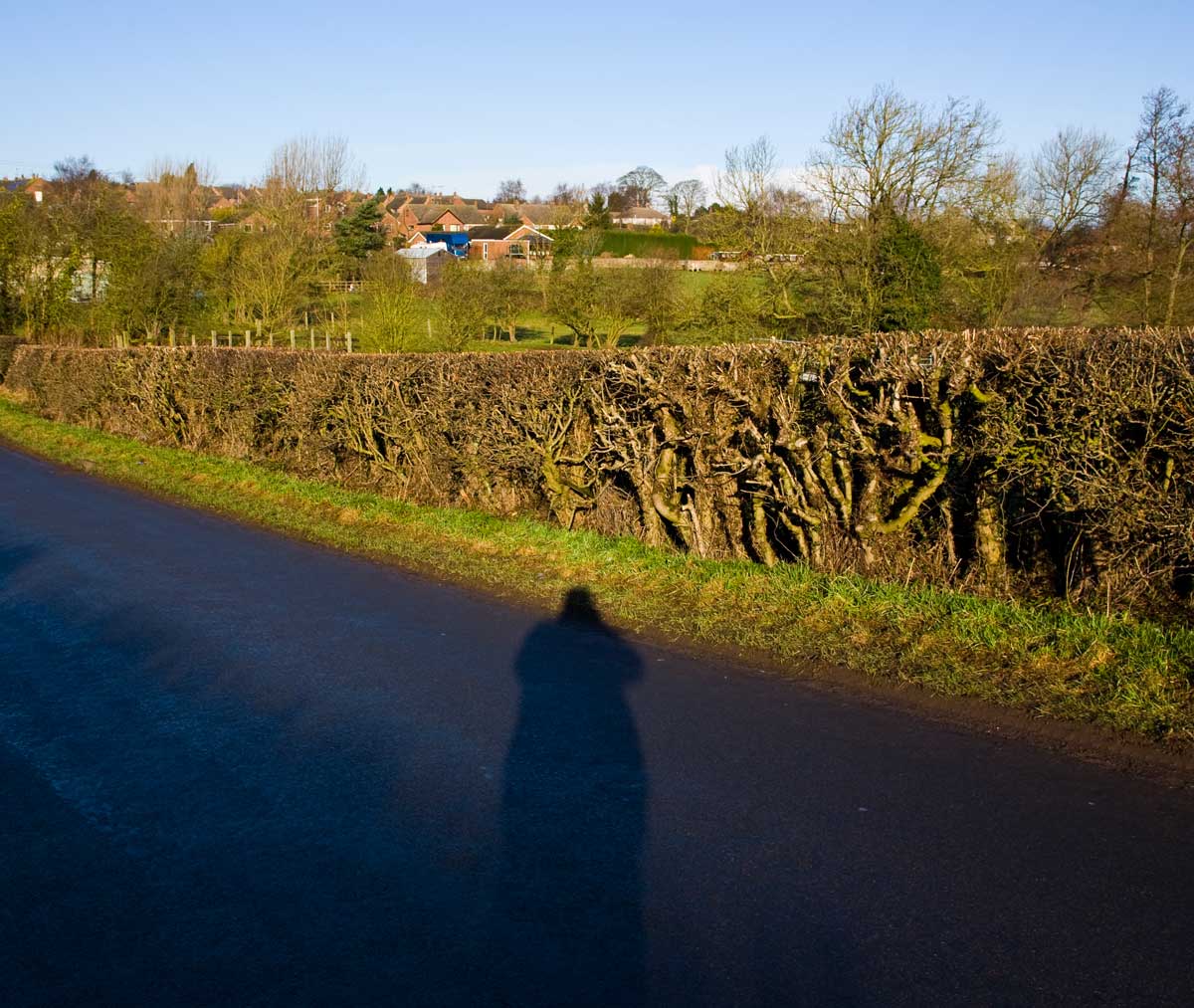
Another bright morning - and only mid February - out in Worthington mopping up the other end of this village. I did intend to travel south but the weather conditions and the traffic on the A42 conspired to make this less than attractive, Snarestone will have to wait whilst Belton is gathered in. Strangely enough I'm due to visit Belton later today with my wife for a meal to celebrate Valentine's Day. So two visits in one day to a place I've probably only set foot in less than half a dozen times in 24 years. I'm beginning to find a passion for simple landscape images, perhaps because the weather is improving and the flora and fauna awakening from winter slumbers. In addition to visits to the villages (and why haven't I tackled the towns yet I wonder?) I want to stop and view the land in a more clearcut topographic way. Why this is so I'm not sure but it allows me to be more overtly romantic in outlook and in the results - not entirely unreasonable on this day!

Sunday, 13 February 2011

Thinking it through


Driving back from the marvellous Bill Gear exhibition in Stow the other day I got to thinking hard about the show of this project. Although I have some forty or so works underway I was beginning to feel quite pressured by the need to complete 90...according to my initial rough plan that was arrived at by multiplying the 45 locations by two (an oil and a digital piece). The size of the gallery was also troubling me - however I looked at it the two main walls seemed ridiculously overcrowded in my mind's eye.

So I rethought the space earlier this week, remeasured and - surprise! - if I rehang to accommodate three high on each wall in two rows of eight on the longer and seven on the shorter...it means 45 can be displayed - one for each location. Not only does this obviate some of the pressure it will enable me to select down from a larger number of canvases with a regard to the totality of the image within the space.

Sometimes it pays not to be too rigid in one's thinking...

Pictures attached... Isley Walton and general view of the studio in early February


Letting Go

Fresh supplies of paint and new brushes combined with a desire for faster progress have seen the project move forward with new vigour. An effort to push the processes into new places is also in evidence - necessitating calls upon the knowledge of what has gone before. One canvas currently owes as much to a close reading of a Cezanne I saw earlier in the week at the Courtauld as it does the source images from the chosen location. Dark blues clash with a pungent cadmium orange overlaid by an equally fierce emerald green. Allowing these more intense colour schemes into the work takes the pictures firmly out of the representational arena - rural Leicestershire in the deep winter rarely reveals such strong colour intensity. However this is not a body of pictures of the topography of the district but more my personal exploration of what painting can be more than a century after cezanne made Le Lac D' Annecy. Much the same can be said of a memory of the button on a coat in a painting by Vincent Van Gogh...see below...!

Thursday, 3 February 2011

Conversations


Conversations in two of this week's locations - Appleby Magna and Stretton en le Field - encapsulate two of the important themes that lie behind the project. In Appleby I meet a man walking his dog (in many of the villages to date, the 'man walking the dog' is the only person I encounter other than workers of some kind, the postman, the builder). Unbidded he begins an exposition on the local history, not least on the local dignitary, Sir John Moore, with whom he has a beef over his involvement in slavery through the East India Company. Grudges, it seems, are carried a long time in rural Leicestershire! But his radical political views (scrap the Lords etc.) and keen sense of history chimes with my own feelings that each location and every image ought to be neither a view, nor even a representation of, each place I visit. Rather it is the sense of history and events, both in the past and present, of details observed and recorded, that make up the shapes, colours and handling of each picture when I return to the computer to upload and manipulate the images made, and then eventually translate these in the studio to paint.

In Stretton I chance upon a single soul, a younger man leaving his parent's property. Initially I think he is drawn to have a conversation as the village is so tiny, a collection of quite grand houses strung out along a single cul de sac, that strangers are a rare occurrence. But it turns out he is a professional photographer, specialising in advertising work making pictures primarily of cars. We have a long discussion on the changing nature of photography, on the ubiquity of the medium, on the ways in which the advent of digital compacts have demystified production of the significant image. It occurs to me after we go our separate ways that my slavish adherence to the quality DSLR and the lenses that I lug around with me may be wholly unnecessary to my purposes - at least in part if not in whole. After all my purposes are fleeting engagements with particular details and moments not a purely topographical record. Quite how this will effect the latter stages of my project I'm not yet sure. But as retrace my steps through Stretton I find myself reaching for the iphone in my pocket and shoot some images with the various picture apps I have on it...


Thursday, 27 January 2011

Worthington


Several more locations visited earlier this week in the brief interlude between thick grey cloud blanket. Although there is yet time some twenty plus locations have yet to be photographed and given that the loose deadline I set myself for this part of the project is fast approaching (I intended to have all my source images completed by end of February) it was important to get some completed this week. I have commented before that it is perhaps surprising how ignorant one can be of places maybe only a few miles and minutes from one's home. On this occasion I found myself wandering through parts of villages I didn't even know existed.

As a topographical exercise I have been recording each of the places of worship and each pub I have come across. A rather sad aspect of this has been the number of pubs that are boarded up...usually within the last few years, months or even weeks. Given that quite a few of the smaller villages have no retail facilities (or post office etc.) pubs might be the one and only sign of life in a tiny hamlet. Certainly all three villages on this trip were utterly silent during the period from 11 in the morning till three thirty in the afternoon. This lends an eerie and elegiac feel to one's meanderings...and especially to the sounds around. In such rural locations sound takes on new significance - from at least a mile away I heard approaching horses and riders - who took twelve or fifteen minutes to pass me. How one can encompass such aural experience in what is essentially a visual project needs much thought.

Tuesday, 18 January 2011

Village Life

Although the paintings are coming along well, some 34 are underway with at least a few completed, the digital images are taking longer to emerge. In part this has been a consequence of the winter conditions that have made it more difficult to progress the shooting of the photographs from which each is derived. The past couple of days have seen improved weather conditions and in turn trips to the villages have yielded some results. However village life in Leicestershire is both quiet and uneventful and especially neat and tidy! Finding fresh visual interest in some places is tougher than one might imagine. The knack seems to be in the little details; the metallic sign wrapped around the post to protect it from the farm traffic; a row of footballs neatly lined up on the bench seat; the strange upright post in the playing field;the incompleted wiring jobs etc. From these come the disjointed and clumsily arranged collaged images that spark off the ways into the paintings.

Thursday, 6 January 2011

How a picture comes together


Part of the point of this diary is to show to some extent how each picture comes together. As part of my intention is to endeavour to keep a singularity within each it is important that I recognise where tropes begin to coalesce. Sealing off certain motifs and techniques is vital to this process. Typically though the process of making each starts with the taking of a set of images in a certain location, these are then subjected to a collaging process within Photoshop - for me it is critical that this doesn't become too sophisticated - and a print is arrived at. This is then taken into the studio and a loose transcription is made onto one of the standard linen canvases. At each stage the variability of the transcription, surfaces, colours and even further alterations to the forms are happily incorporated into the methodology. Describing all this makes it seem random and haphazard and I suppose this is so. However I make the choices and decisions with my own internal dialogue that at the very least means that it is directed by some sort of narrative albeit maybe one that only I am interested in! I picked up a catalogue at the studio today that had a statement in it from the artist Michael Finn. Finn was Principal at Falmouth School Of Art when I was a student there. I admired him and latterly have admired his art. He wrote that "I am rather in the dark about what I do except that it feels right for me and seems to be within a tradition that is nearly a century old and yet it is still possible to make something very personal, which I think is wonderful". I rather feel that it is wonderful too.